
Health Library
Medicines for asthma
You must carefully read the "Consumer Information Use and Disclaimer" below in order to understand and correctly use this information
What do asthma medicines do?
If you or your child has asthma, the medicines the doctor prescribes can:
Open the airway (figure 1) – This helps the muscles in the airway relax and lets air flow more easily.
Reduce inflammation – This helps calm inflammation in the airway, which can help prevent asthma symptoms from happening.
Which medicines might I need?
Doctors can use different medicines to treat asthma. These include inhalers, liquids, and pills. You might take 1 or more, depending on how often you have symptoms and how serious they are. Your doctor might change which medicine you take, and how much, over time.
There are 2 main types of asthma medicines:
Quick-relief medicines – These open the airway quickly to treat asthma attacks. They can reduce symptoms in 5 to 15 minutes.
Long-term controller medicines – These help reduce inflammation in the long term. This can help prevent asthma symptoms from happening. People take these 1 to 2 times a day every day, even if they have no symptoms.
When these medicines are put into inhalers, many people have 1 inhaler for quick relief and 1 for long-term control. But a person might use 1 inhaler for both.
The most common options for treating and preventing asthma symptoms are listed below. For children with asthma, some medicines are only available after a certain age. Your child's doctor or nurse will tell you which medicines your child is old enough to take.
Quick-relief inhalers
These are prescription medicines put into inhalers you take to relieve asthma symptoms when they happen. Everyone with asthma should have a quick-relief inhaler to use during an asthma attack. Most people need them 1 or 2 times a week, or less often. But when asthma symptoms get worse, you might need more doses.
Quick-relief inhalers include:
Short-acting beta agonists ("SABAs") – These relax the muscles in the airway. They are also called "short-acting bronchodilators."
SABAs can help stop an asthma attack. Also, if you have asthma symptoms when you exercise, it can help to use a SABA 5 to 20 minutes before exercise.
Some examples of SABAs are albuterol (sample brand names: ProAir HFA, Proventil HFA, Ventolin HFA) and levalbuterol (brand name: Xopenex HFA). "HFA" means the medicine comes in a metered dose inhaler (figure 2). Albuterol also comes in another type of inhaler called a dry powder inhaler (sample brand name: ProAir RespiClick).
Albuterol with an inhaled steroid – These are medicines that come in 1 inhaler. Albuterol is a type of SABA. Inhaled steroids are a type of controller medicine that reduce inflammation in the airway.
Like inhalers that only have a SABA, you can use an inhaler with albuterol to help stop an asthma attack. When you use it, the steroids calm inflammation in your lungs. This can help decrease the chance of having more serious asthma attacks. This type of inhaler should not be used as a controller, even though steroids are a type of controller medicine. This can be confusing. If you have questions about when or how to use your asthma medicines, your doctor or nurse can help.
An example of an inhaler with albuterol and inhaled steroid is albuterol with budesonide (brand name: Airsupra).
Formoterol with an inhaled steroid – Formoterol is a type of long-acting beta agonist ("LABA"). LABAs relax the muscles in the airway, like SABAs do. But the effects last much longer.
Most LABAs start working slowly, but formoterol works just as fast as a SABA. Because of this, it can be used to help stop an asthma attack. Formoterol is always combined with a steroid in 1 inhaler. Some people can use this inhaler as a long-term controller, too. Some people who have asthma symptoms during exercise can also use it 5 to 20 minutes before exercise. Your doctor can talk to you about whether this type of inhaler is an option for you. Some insurance plans might not cover it.
Some examples of this combination of medicines are budesonide with formoterol (brand names: Breyna, Symbicort) and mometasone with formoterol (brand name: Dulera).
Some people feel shaky after using certain quick-relief inhalers. If this happens, your doctor or nurse might tell you to use just 1 puff next time. Or they might give you a different medicine.
There is a type of SABA called "epinephrine" that is sold without a prescription. It comes in an inhaler (brand name: Primatene Mist) or as a liquid you breathe in through a small device (brand name: Asthmanefrin). These non-prescription inhalers can cause dangerous side effects, especially if you use too many puffs. Because of this, doctors generally do not recommend them.
Controller medicines
These are prescription medicines you take every day to help prevent asthma symptoms. They usually cannot be used for quick relief. Not everyone with asthma needs them. But people who need controller medicines take them every day, even if they have no symptoms. You might need a controller medicine if, for example, you have asthma symptoms more than 2 times a week. When these medicines are working well, your asthma symptoms are controlled, and you should not need quick-relief medicines very often.
Controller medicines include:
Inhaled steroids – These reduce inflammation in the airway. They can take a few days to work, so you will not feel the effect right away. They help prevent symptoms and asthma attacks in the future.
Inhaled steroids come in different kinds of inhalers. Your doctor or nurse will show you how to use the inhaler. Each inhaler has its own directions.
It is rare for these medicines to cause side effects. The doctor will give you the lowest dose that works well. This reduces the chances of any side effects.
Some people worry about side effects of steroid inhalers, so they avoid using their inhaler or giving it to their child. But the truth is not using a steroid inhaler is much riskier than any side effects it might cause. Inhaled steroids help prevent asthma attacks from starting. These attacks can be dangerous and even cause death. Plus, asthma damages the lungs over time. Inhaled steroids can prevent some of that damage.
Some examples of inhaled steroids are budesonide (brand name: Pulmicort Flexhaler), ciclesonide (brand name: Alvesco), fluticasone (brand name: Arnuity Ellipta), and mometasone (brand name: Asmanex Twisthaler).
Inhaled steroids plus a long-acting beta agonist ("LABA") – LABAs relax the muscles around the airway. The effects last a long time.
You should only use a LABA at the same time as an inhaled steroid medicine. So it is best to use 1 inhaler that has both medicines. Some LABAs come in an inhaler without the steroid, but you must take them at the same time as a separate steroid inhaler. This combination of medicines can usually only be used for long-term control. But inhalers that have the LABA formoterol, discussed above, can also be used for quick relief.
Medicines that have a LABA and steroid in 1 inhaler include fluticasone with salmeterol (brand names: Advair Diskus, Advair HFA, Wixela), fluticasone with vilanterol (brand name: Breo Ellipta), and budesonide with formoterol (brand names: Breyna, Symbicort).
Leukotriene modifiers – These reduce inflammation. They come as pills. But they do not work for everyone. This is because they are not as strong as inhaled steroid medicines.
Some examples of leukotriene modifiers are montelukast (brand name: Singulair), zafirlukast (brand name: Accolate), and zileuton.
Tiotropium – This is a long-acting muscarinic agent ("LAMA"). It helps relax the muscles in the airway. It comes in an inhaler (brand name: Spiriva Respimat). It is more often used to treat a lung disease called "COPD." But if other medicines have not worked well, it is sometimes used to control asthma symptoms.
Combination inhaled steroid and dual bronchodilator – This comes in an inhaler with a steroid, LAMA, and LABA. In the US, the combination inhalers of this type approved for asthma treatment are fluticasone-umeclidinium-vilanterol (brand name: Trelegy) and budesonide-glycopyrrolate-formoterol (brand name: Breztri). A similar medicine called mometasone-glycopyrrolate-indacaterol (brand name: Enerzair) is available in Canada and Europe.
Medicines for more severe asthma
People with more severe symptoms might get other medicines, too. Your doctor can talk to you about whether any of these might be an option for you. They include:
Omalizumab (brand name: Xolair) – You might get this medicine if your asthma is caused by allergies and inhaled steroids do not work well. It comes as a shot.
Medicines to reduce inflammation – If your blood tests show a high level of white blood cells called "eosinophils," you might get certain medicines to reduce inflammation. Examples include benralizumab (brand name: Fasenra), dupilumab (brand name: Dupixent), mepolizumab (brand name: Nucala), tezepelumab (brand name: Tezpire), reslizumab (brand name: Cinqair), and depemokimab (brand name: Exdensur). Your doctor might prescribe tezepelumab even if your eosinophil levels are not high. Benralizumab, dupilumab, mepolizumab, tezepelumab, and depemokimab come as a shot. Reslizumab is given through a thin tube that goes into a vein, called an "IV."
Steroid pills – If other asthma medicines do not work well or you have an asthma attack after a cold virus, you might need to take steroid pills for a few days or weeks. Some people with severe asthma take steroid pills for several months or longer, but this is rare. Some examples of steroid pills for asthma are prednisone and methylprednisolone.
Where can I get more information about asthma medicines?
If you want more detailed information, such as the side effects caused by specific medicines, ask your doctor or nurse for the patient drug information handout from UpToDate. It explains how to use each medicine, describes its possible side effects, and lists other medicines or foods that can affect how it works.
What else should I know about asthma medicines?
Take all the medicines your doctor prescribes, exactly as instructed. Remember, your controller medicines are helping you even if you do not feel them working.
Use your asthma "action plan" if you have one. This is a list of instructions that tells you:
Which medicines to use every day
Which ones to take if your symptoms get worse
When to get help or call for an ambulance
If you do not have an asthma action plan, ask your doctor if you need one.
Images
figure 1: Asthma
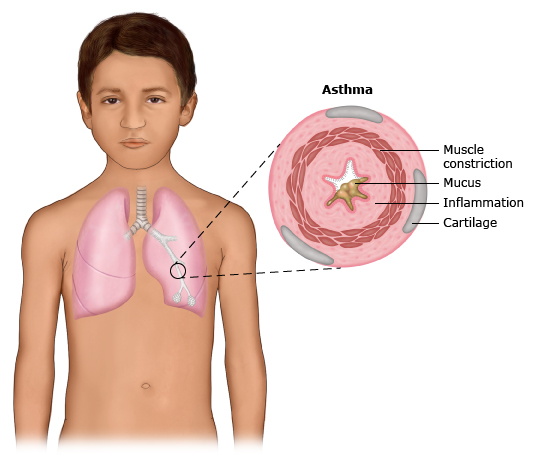
During an asthma attack or flare-up, the muscles around the airways tighten (constrict), and the lining of the airways gets inflamed. Then, mucus builds up. All of this makes it hard to breathe.
Graphic 65956 Version 11.0
figure 2: Metered dose inhaler
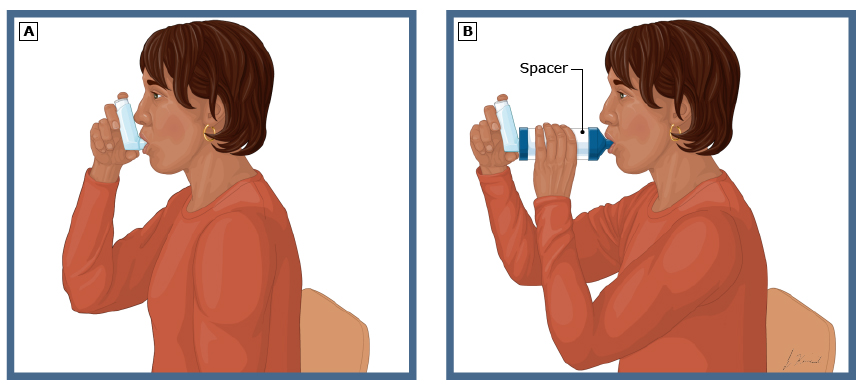
Medicine is stored in the canister. When you press down on the top of canister, the medicine is released from the chamber and sprayed out of the mouthpiece.
Graphic 61575 Version 9.0
Give to a Healthier Future
Help us elevate and expand our care, make breakthroughs in biomedical science and improve community health and wellness.
Healthier communities. Healthiest lives. Together.