
Health Library
Weight-Bearing Exercises
You must carefully read the "Consumer Information Use and Disclaimer" below in order to understand and correctly use this information
About this topic
Weight-bearing exercise is any activity that you do while standing up. This means you build strong bones and muscles as they work against the force of gravity. Your bones get stronger as you exercise and move about.
The best time to build bone strength is in your growing years. Bones still grow into your 20s or early 30s. It is also important to do weight-bearing exercises after the mid-30s. That is when bone loss often begins.
Severe bone loss may also be called osteoporosis. Mild bone loss is called osteopenia. It is a health problem where the amount of bone gets smaller and weaker. People with osteoporosis should do weight-bearing exercises to prevent more bone loss and broken bones.
Weight-bearing exercise may include:
Brisk walking, hiking, or running
Aerobics, dancing, or climbing stairs
Sports like:
Basketball
Bowling
Golf
Tennis
Skiing
Skating
Baseball
Karate
Soccer
Tai Chi or yoga
Pushing a lawnmower
Using free weights while standing up
Activities that are good for your heart and lungs but are NOT weight-bearing exercises:
Cycling
Swimming
General
Before starting with a program, ask your doctor if you are healthy enough to do these exercises. Your doctor may have you work with a trainer or physical therapist to make a safe exercise program to meet your needs.
Strengthening Exercises
Strengthening exercises keep your muscles firm and strong. Start by repeating each exercise 2 to 3 times. Work up to doing each exercise 10 times. Try to do the exercises 2 to 3 times each day. Do all exercises slowly.
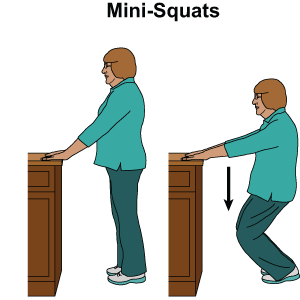
Mini-squats − Stand up straight in front of a counter and hold on with your hands. Have your feet spread about a foot apart. Bend your knees while keeping your back straight. Hold for 3 to 5 seconds. Return to straight standing position. At first, start by just having a slight bend at the knee. To make it harder, bend your knees deeper or hold the position longer. Do not go any lower than 90 degrees.
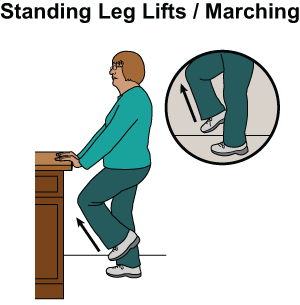
Standing leg lifts / marching − Hold onto a counter. March in place, holding each leg up for 3 to 5 seconds.
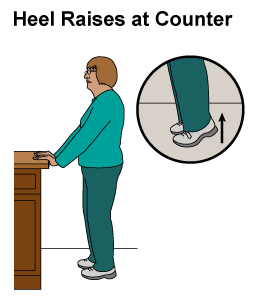
Heel raises − Hold onto a counter. If you feel steady, you may do this with your walker in front of a chair. Lift your heels up and rise up onto your toes. Hold for 3 to 5 seconds. Lower yourself back down.
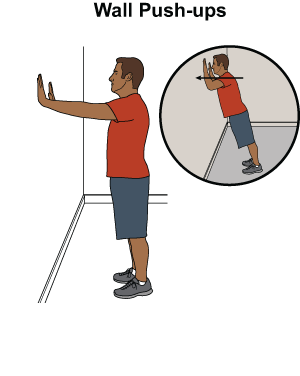
Wall push-ups − Stand about 18 inches (45 cm) away from a wall. Place your hands on the wall in front of both shoulders. Keeping your back straight, lean forward by bending your elbows until your face almost touches the wall. Now, straighten the elbows and push your body away from the wall. As this gets easier, try doing a push-up leaning on a counter to put more body weight through your arms.
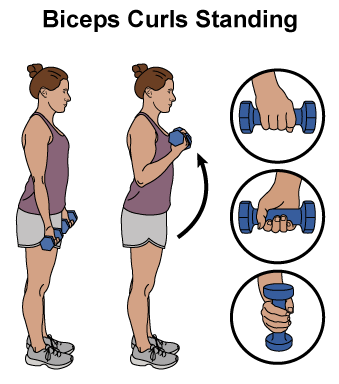
Doing exercise with weights while standing are weight bearing exercises. For example, you can do biceps curls using free weights.
Choose a weight that will let you to repeat the exercise 10 times before resting. Work your way up to 3 sets of 10 before raising the weight. If you are not able to do 10 repetitions, you are using too heavy of a weight.
Bicep curls using free weights − Stand with your feet about shoulder width apart. Keep your weight equal on both feet. Hold the weights in front of you with your palms facing up. Bend your elbow and slowly move your lower arm towards your chest. Do not move your shoulder. Hold this position for 2 seconds and lower your arm to the starting position. You may exercise both arms at the same time. You can also do this exercise with different hand positions. Try doing this exercise with thumbs pointed up or palms facing down to get all parts of the biceps muscle.
Image(s)
What will the results be?
Stronger bones
Stronger muscles
Less bone loss
Improve coordination and balance
Helpful tips
Stay active and work out to keep your muscles strong and flexible.
Keep a healthy weight to avoid putting too much stress on your joints. Eat a healthy diet to keep your muscles healthy.
Be sure you do not hold your breath when exercising. This can raise your blood pressure. If you tend to hold your breath, try counting out loud when exercising. If any exercise bothers you, stop right away.
Try walking or cycling at an easy pace for a few minutes to warm up your muscles. Do this again after exercising.
If you have osteoporosis, try to avoid weight bearing activities that may put you at risk for falling like skiing and skating.
Try to add more walking into your daily routines to get more weight-bearing exercise:
Take the stairs instead of going on an elevator.
Park far away from places to get in more steps.
Exercise may be slightly uncomfortable, but you should not have sharp pains. If you do get sharp pains, stop what you are doing. If the sharp pains continue, call your doctor.
Give to a Healthier Future
Help us elevate and expand our care, make breakthroughs in biomedical science and improve community health and wellness.
Healthier communities. Healthiest lives. Together.