
Health Library
Lateral Raises Using Free Weights
You must carefully read the "Consumer Information Use and Disclaimer" below in order to understand and correctly use this information
About this topic
A lateral raise is an exercise that works your deltoid muscle. This muscle forms the rounded shape of your shoulder.
This exercise uses weights to make your muscles work harder. There are 4 types of free weights. They are dumbbells, barbells, kettlebells, and medicine balls. The one you use is based on the exercise that you do. Use weights that are heavy enough for you to lift a few times. Do not use heavier weights unless ordered by your physical therapist.
If you have shoulder problems, doing this exercise could make your problem worse.
General
Before starting with a program, ask your doctor if you are healthy enough to do these exercises. Your doctor may have you work with a trainer or physical therapist to make a safe exercise program to meet your needs.
Strengthening Exercises
Strengthening exercises keep your muscles firm and strong. Choose a weight that will let you to repeat the exercise 10 times before resting. Work your way up to 3 sets of 10 before raising the weight. If you are not able to do 10 repetitions, you are using too heavy of a weight.
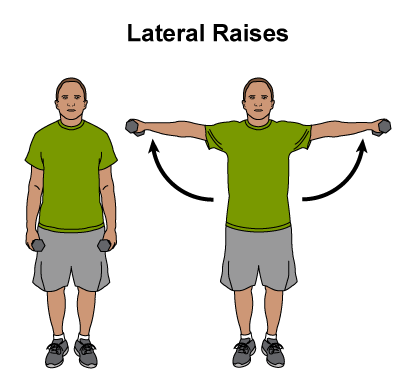
How to do a lateral raise:
Stand with feet slightly apart.
Hold one weight in each hand. Your hands should be at your sides.
Keep your elbows slightly bent with thumbs pointing up. Slowly, raise the weights straight out to the sides to just below shoulder level. Your body should look like the letter "T" in this position. Breathe out while you lift your arms up. Hold your position for 3 seconds.
Slowly, lower your arms to the starting position. Control your muscles while lowering your arms. Breathe in while you lower your arms.
Image(s)
What will the results be?
Doing lateral raises may help make your deltoid muscle stronger and more toned.
Helpful tips
Stay active and work out to keep your muscles strong and flexible.
Keep a healthy weight to avoid putting too much stress on your joints. Eat a healthy diet to keep your muscles healthy.
Be sure you do not hold your breath when exercising. This can raise your blood pressure. If you tend to hold your breath, try counting out loud when exercising. If any exercise bothers you, stop right away.
Try walking and swinging your arms at an easy pace for a few minutes to warm up your muscles. Do this again after exercising.
Avoid working out the same muscle groups for 2 days in a row. Your muscles need rest to get better.
Exercise may be slightly uncomfortable, but you should not have sharp pains. If you do get sharp pains, stop what you are doing. If the sharp pains continue, call your doctor.
Give to a Healthier Future
Help us elevate and expand our care, make breakthroughs in biomedical science and improve community health and wellness.
Healthier communities. Healthiest lives. Together.