
Health Library
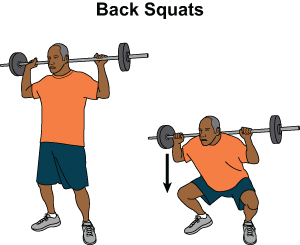
Back Squats Using Free Weights
You must carefully read the "Consumer Information Use and Disclaimer" below in order to understand and correctly use this information
About this topic
Back squats strengthen the legs, hips, core and back. This exercise uses control and balance since there is no machine that supports the weights.
This exercise uses weights to make your muscles work harder. You may use dumbbells, which are also known as free weights, or barbells based on the exercise. Use weights that are heavy enough for you to lift a few times. Do not use heavier weights unless ordered by your physical therapist.
General
Before starting with a program, ask your doctor if you are healthy enough to do these exercises. Your doctor may have you work with a trainer, chiropractor or physical therapist to make a safe exercise program to meet your needs.
Back squats using free weights:
Practice a couple of squatting exercises without weights before doing them with weights.
Grip the bar portion of the barbell securely and comfortably. Your palms should be down when your grab the bar from the floor. When you lift the bar up, your hands will be facing forward. Your hands should be slightly more than shoulder width apart.
Place the bar across your upper back at your shoulder height.
Position your feet shoulder width apart. Point your toes slightly outward.
Slowly, bend your knees until your thighs are level or parallel to the floor. Control the muscles in your hips and knees as you squat. Keep your chest up and abs tight when you are doing this.
Breathe in while you bend your knees.
Keep your feet flat on the floor.
Put your weight more on the back of your feet. Push yourself back to standing position.
Breathe out while you stand up. This will help move you to a standing position.
Keep the barbell steady on your upper back.
Repeat back squats. Your trainer will tell you how many sets to do in a session.
Image(s)
What will the results be?
Stronger and more toned looking muscles in your legs, hips, and back
Greater ease doing leg activities
Better sports performance
Improved balance
Helpful tips
Stay active and work out to keep your muscles strong and flexible.
Keep a healthy weight to avoid putting too much stress on your joints. Eat a healthy diet to keep your muscles healthy.
Be sure you do not hold your breath when exercising. This can raise your blood pressure. If you tend to hold your breath, try counting out loud when exercising. If any exercise bothers you, stop right away.
Try walking or cycling at an easy pace for a few minutes to warm up your muscles. Do this again after exercising.
Avoid working out the same muscle groups for 2 days in a row. Your muscles need rest to get better.
Have someone nearby who can help you with the weight if it gets too heavy.
Exercise may be slightly uncomfortable, but you should not have sharp pains. If you do get sharp pains, stop what you are doing. If the sharp pains continue, call your doctor.
Wear a weight lifting belt to help support and protect the low back.
Give to a Healthier Future
Help us elevate and expand our care, make breakthroughs in biomedical science and improve community health and wellness.
Healthier communities. Healthiest lives. Together.