
Health Library
Renovascular hypertension
You must carefully read the "Consumer Information Use and Disclaimer" below in order to understand and correctly use this information
What is renovascular hypertension?
This is a type of high blood pressure. It happens when the renal arteries (the blood vessels that carry blood to the kidneys) become narrow (figure 1). Renovascular hypertension is sometimes called "renal artery stenosis."
High blood pressure puts you at risk for heart attack, stroke, and kidney disease. It does not usually cause symptoms. But it can be serious.
When your doctor or nurse tells you your blood pressure, they say 2 numbers. For instance, your doctor or nurse might say your blood pressure is "140 over 90." The top number is the pressure inside your arteries when your heart is contracting. The bottom number is the pressure inside your arteries when your heart is relaxed.
This table shows how doctors and nurses define high and normal blood pressure (table 1).
Will I need tests?
Maybe. If you have renovascular hypertension, your doctor might be able to hear a "whooshing" sound when listening to your belly through a stethoscope.
The doctor can also order imaging tests that create pictures of your renal arteries. But these are only done if the doctor thinks a procedure to open up your arteries could be helpful.
Should I see a doctor or nurse?
See your doctor or nurse right away if you have high blood pressure and get any of these symptoms:
Very bad headache
Chest pain
Severe pain in your upper back
Problems breathing
Weakness on only 1 side of your body
Problems speaking
Nausea or vomiting
Confusion
Vision changes
Blood in your urine
These can be signs of a very serious type of high blood pressure that needs to be treated as soon as possible.
How is renovascular hypertension treated?
Treatments include medicines for high blood pressure, such as:
ACE inhibitors and ARBs – These are often grouped together because they work in similar ways. They can help prevent kidney disease.
Some examples of ACE inhibitors include enalapril, captopril, and lisinopril.
Some examples of ARBs include candesartan (brand name: Atacand) and valsartan (brand name: Diovan).
Diuretics – Some examples include chlorthalidone, hydrochlorothiazide ("HCTZ"), and furosemide (brand name: Lasix).
Calcium channel blockers – Some examples include amlodipine (brand name: Norvasc), felodipine (brand name: Plendil), and diltiazem (brand name: Cardizem). These medicines also help prevent chest pain caused by heart disease.
Beta blockers – Some examples include atenolol (brand name: Tenormin), metoprolol (brand names: Lopressor, Toprol-XL), and propranolol (brand name: Inderal LA).
For more detailed information about these medicines, ask your doctor or nurse for the patient drug information handout from UpToDate. It explains how to use each medicine, describes its possible side effects, and lists other medicines or foods that can affect how it works.
Your doctor might recommend a procedure called "angioplasty" to open up 1 (or possibly both) of your renal arteries. During angioplasty, the doctor puts a thin tube into a blood vessel in your leg and advances the tube to your kidney. Then, they inflate a tiny balloon inside the clogged artery to reopen it. They often prop open the artery using a tiny mesh tube called a "stent." Doctors only recommend angioplasty in certain situations.
Can renovascular hypertension be prevented?
You can reduce your chances of getting it by keeping your blood vessels healthy. To do that, you should:
Quit smoking, if you smoke. Your doctor or nurse can help.
Walk or do some kind of physical activity on most days of the week.
Lose weight, if you have excess body weight.
Images
figure 1: Blood vessels supplying the kidneys
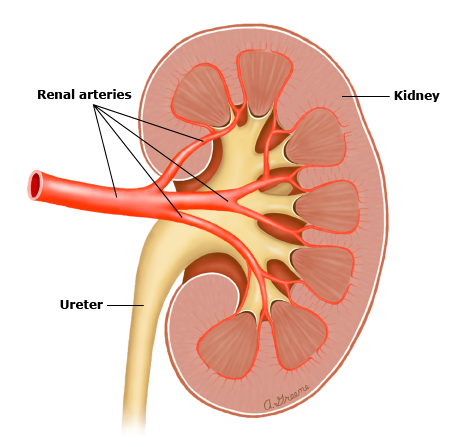
The blood vessels leading to the kidney are called the renal arteries. If your renal arteries get narrow, your blood pressure rises. This type of high blood pressure is called renovascular hypertension.
Graphic 70583 Version 2.0
Level | Top number | Bottom number |
|---|---|---|
High | 130 or above | 80 or above |
Elevated | 120 to 129 | 79 or below |
Normal | 119 or below | 79 or below |
These definitions are from the American College of Cardiology/American Heart Association. Other expert groups might use slightly different definitions.
"Elevated blood pressure" is when your blood pressure is not as low as it should be for good health, but is not yet high blood pressure.
Graphic 59480 Version 7.0
Give to a Healthier Future
Help us elevate and expand our care, make breakthroughs in biomedical science and improve community health and wellness.
Healthier communities. Healthiest lives. Together.