
Health Library
Preventive health care for ages 65 and older
You must carefully read the "Consumer Information Use and Disclaimer" below in order to understand and correctly use this information
What is preventive health care?
This is any medical treatment, test, or behavior to try to prevent a health problem before it happens.
Some of the most important steps you can take are listed below.
Lead a healthy lifestyle – People don't usually think of lifestyle changes as a form of "treatment." But some lifestyle changes can be as effective as medicines for preventing health problems. If you have healthy habits, you might be less likely to develop many health problems than people who do not have these habits.
A healthy lifestyle includes:
Getting plenty of physical activity
Eating healthy foods
Keeping a healthy body weight
Avoiding or limiting alcohol
Avoiding smoking
See your doctor or nurse regularly – During each visit, they will talk to you about your physical and mental health, do an exam, and review your medicines. They will also:
Ask about your habits and behaviors
Ask about your family's medical history – This can help tell them if you are at a higher risk of developing certain health problems, such as diabetes or cancer.
Do some routine checks, like measuring your weight and blood pressure, to help keep track of your health
Recommend screening tests and vaccines based on your age, sex, and situation
Take medicines to help prevent problems – You might need to take medicines to lower your risk of heart attack, stroke, or other problems. Or you might need to take calcium and vitamin D supplements to reduce the risk of breaking a bone.
Get dental exams – Most people should see a dentist 1 to 2 times a year for a cleaning and check-up. This can help keep teeth and gums healthy. The dentist can also find problems like cavities and gum disease early, when they are easier to treat.
Get eye exams – Everyone should have an eye exam every 2 to 4 years before age 64. People who have vision problems or wear glasses or contacts might need to have their eyes checked more often. During an eye exam, the doctor also looks inside your eyes to check for problems.
Why is my age important?
As you get older, the way your body responds to medical problems changes. For example:
Your body cannot fight infections as well. That's why it is more important to get certain vaccines.
The way your body responds to medicines can change. That's because the liver and kidneys, which break down medicines, do not work as well as they once did.
Certain diseases become more common. For example, most forms of cancer and heart disease develop more often in older people than in younger people.
Always check with your doctor about any changes to your body or your health. That way, you can find out if the changes might be a problem, and if there are any treatments that might help.
What are screening tests?
These are tests that check for early signs of a disease before the disease causes symptoms or problems. Screening tests might check your future risk of having a medical problem. Many check for cancer, but there are other screening tests, too.
All people should get some screening tests. But you might need other tests based on your sex or age. When to start screening and how often to screen often depend on your situation and "risk factors." Risk factors are things that affect how likely you are to get a disease or other health problem.
As you get older, you might no longer need some screening tests. If your doctor suggests you no longer need a screening test, such as a Pap test, mammogram, or colon cancer test, this does not mean they think you are too old to care about. Since many cancers take a long time to develop, screening as you get older might not help and can even be harmful. That's because in some cases, screening can lead to unnecessary treatment.
Screening tests often recommended for people 65 and older include:
Blood pressure checks – Most people need to have their blood pressure checked at least every 2 years. You might need more frequent checks if you:
Have or are at risk for conditions like diabetes, heart disease, and kidney disease
Have excess body weight
Have family members with high blood pressure
Had high blood pressure while pregnant
Cholesterol screening – Cholesterol is a substance in the blood called a "lipid." Lipids are types of fats. High levels of lipids can increase your risk of heart attack, stroke, and other health problems.
Diabetes or prediabetes screening – Diabetes is a disorder that disrupts how the body uses sugar. People at increased risk of diabetes typically need diabetes screening every 3 years starting at age 35. Diabetes screening should be repeated every 3 years. You might need more frequent checks if your test results are abnormal.
Screening for osteoporosis – Osteoporosis is a disease that makes bones thin, weak, and more likely to break. Screening for osteoporosis involves tests to check how dense your bones are. Your doctor might suggest this if you are over 65.
Colorectal cancer screening – This can detect polyps and cancers in the colon or rectum before they cause symptoms. Screening might also potentially lower the chance of dying from colorectal cancer. Your doctor will likely suggest this screening if you are age 45 to 75, based on your risk factors.
Lung cancer screening – Doctors suggest screening for certain people who are at high risk of lung cancer because they smoke, or used to smoke. Your doctor might suggest this screening if you are age 50 to 80, based on your risk factors.
Screening for depression and anxiety – Most people should be screened for depression and anxiety. This is important because it can help doctors and nurses figure out who might need help. Depression and anxiety can be treated.
Counseling on lifestyle-related topics – These include smoking, weight management, healthy eating, alcohol and tobacco use, and intimate partner violence. Screening for these problems can help doctors and nurses find potential risks early.
You need some screening tests at least once in your life, and maybe more often depending on your lifestyle and health history. This includes screening for:
Hepatitis B
Hepatitis C
HIV
You might get other screening tests based on your situation. For example, if you have any new sex partners, your doctor might recommend screening for sexually transmitted infections.
Females might also need:
Cervical cancer screening – Doctors can use a few tests to find cervical cancer and precancer in the early stages, when it can be treated or even cured. You might need cervical cancer screening if you did not had adequate screening in the past or have new sexual partners.
Breast cancer screening – This is a way to check for problems in people who do not have any symptoms, like a lump in the breast. Getting screened lowers your chance of dying from breast cancer. Your doctor might suggest breast cancer screening every 1 to 2 years between the ages of 40 and 74, based on your risk factors.
Males might also need:
Prostate cancer screening – This is a way to check the prostate gland for signs of cancer, even if you have no symptoms. Your doctor might suggest prostate cancer screening starting at age 40 to 50, based on your risk factors.
Screening for "abdominal aortic aneurysm" – An abdominal aortic aneurysm is a swelling of the main blood vessel that feeds the lower half of the body. Your doctor might recommend screening for this condition once between the ages of 65 and 75 if you have ever smoked, or if you have a close relative who died from or needed surgery for an abdominal aneurysm.
What are vaccines?
These are shots ("injections") that help protect you from certain infections, like the flu and pneumonia. Your doctor or nurse can talk to you about which vaccines you should get and when.
Experts recommend people ages 65 and older get:
The flu vaccine once a year – Ask about getting the high-dose version, if it is available. In older people, the high-dose version works a little better than the standard-dose version. But the standard dose is also helpful.
Vaccines to prevent COVID-19
A pneumonia vaccine – Pneumonia is a lung infection that can cause a fever, cough, and trouble breathing. You might need 2 pneumonia vaccines.
A tetanus-diphtheria ("Td") vaccine booster, probably once every 10 years. (A "booster" is a vaccine dose you get some time after the first dose. It reminds your body how to prevent an infection.) Some experts think it's OK to get Td boosters less often.
A pertussis vaccine – Pertussis, also called "whooping cough," is an infection that can cause a severe cough. It can also cause severe breathing trouble in babies and children, as well as adults. It is especially important to get vaccinated if you have a newborn or spend a lot of time around babies. The pertussis vaccine might also come in the same shot as the Td vaccine.
A hepatitis B vaccine – Hepatitis B is a serious disease caused by a virus. It can cause long-term liver problems or liver cancer. Doctors often recommend this vaccine for all adults under age 60.
A shingles vaccine – Shingles is a painful rash caused by a virus. The shingles vaccine can lower your chance of getting shingles. It might also make symptoms milder if you do get shingles. Doctors often recommend the shingles vaccine for adults over age 50.
A respiratory syncytial virus, or "RSV," vaccine – RSV is a lung infection that can be serious in older adults. Doctors might recommend this vaccine after age 60.
Other vaccines if they didn't get them as children or teens
How else can I stay as healthy as possible?
You should:
Try to avoid falling – Here are some things that might help:
Make sure all walkways in your home are well lit and clear of clutter, electrical cords, and loose rugs. Tuck electric cords out of the way, and secure them to the wall or floor. Make sure loose rugs have nonskid backing, so they won't slip (figure 1).
Wear sturdy, comfortable shoes.
Try to stay active. People who do some kind of exercise are less likely to fall than people who don't.
Review your medicines with your doctor. Some medicines, such as sleeping pills, can increase your risk of falling and can be unsafe as you get older.
Ask your doctor if it is still safe to drive – This is a tough question to ask, but it's important. As people get older, they sometimes have vision and hearing loss, and they react more slowly to things. These changes can increase the risk of car accidents.
Talk to your doctor or nurse if you have trouble controlling your bladder or bowels – This is called being "incontinent." If you have this problem, don't be embarrassed to ask your doctor or nurse about it. Many treatments are available.
Keep an up-to-date medicine list – Always bring your medicine list with you when you see a doctor or nurse. An example is at the following website: www.fda.gov/media/73856/download.
Get help with bills or meals if you need it – If you cannot afford to pay your bills or have trouble making meals for yourself, there might be services in your area that can help. This website is a good place to start: www.eldercare.acl.gov/Public/Index.aspx.
Stay socially connected – Social connection is important for good health. Tell your doctor or nurse if you spend almost all your time alone. They can help you find ways to meet new people and get involved in new activities.
Tell your doctor if you are being hurt, neglected, or cheated
If any of your family members or caregivers are mistreating you, stealing money, or taking advantage of you in any way, tell your doctor. They can get you the help you need.
Images
figure 1: How to avoid falling at home
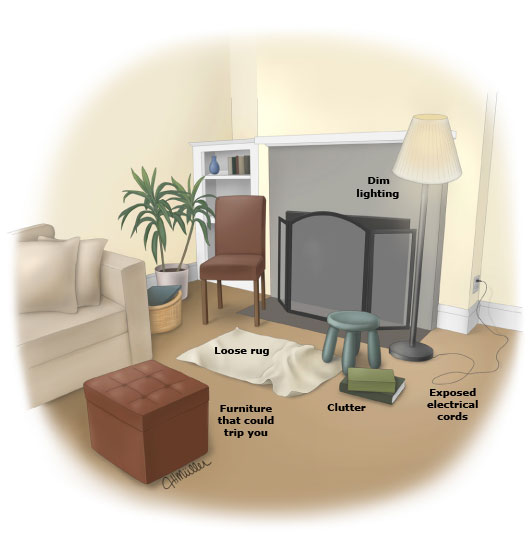
This picture shows some of the things that can cause a fall in your home. Look around and remove any loose rugs, electrical cords, clutter, or furniture that could trip you.
Graphic 72890 Version 1.0
Give to a Healthier Future
Help us elevate and expand our care, make breakthroughs in biomedical science and improve community health and wellness.
Healthier communities. Healthiest lives. Together.