
Health Library
Weight loss surgery
You must carefully read the "Consumer Information Use and Disclaimer" below in order to understand and correctly use this information
What is weight loss surgery?
Weight loss surgery, also called "bariatric surgery," is surgery to help you lose weight. It works by making you take in fewer calories and nutrients.
Who can have weight loss surgery?
Doctors use a measure called "body mass index," or "BMI," to decide who is underweight, at a healthy weight, or overweight. Your BMI tells you which category you are in based on your weight and height (table 1).
Weight loss surgery is appropriate only if you could not lose weight in other ways, and if you:
Have a BMI above 35
Have a BMI above 30, and have a medical problem related to obesity, such as diabetes, heart disease, or high blood pressure
For people who are Southeastern Asian or Indian, weight loss surgery might be an option for people with a slightly lower BMI than the numbers above. That's because people in these groups are more likely to carry weight around their middle, which can raise the risk of health problems.
What are the different types of weight loss surgery?
There are many different types. The most common are:
Gastric bypass (figure 1) – Gastric bypass is short for "Roux-en-Y gastric bypass." It is sometimes called "RYGB." For this surgery, the doctor closes off part of the stomach, leaving only a small pouch for food. Then, they connect the stomach pouch to the middle part of the small intestine. This lets food "bypass" (go around) part of the stomach and small intestine.
There are other surgeries that are similar to gastric bypass in how they cause weight loss.
Gastric sleeve (figure 2) – This is surgery to turn the stomach into something that looks like a sleeve. It is also called "sleeve gastrectomy." For this surgery, the doctor removes a large portion of the stomach and leaves a narrow tube.
How is weight loss surgery done?
In the US, almost all gastric bypass and gastric sleeve procedures are done as "laparoscopic" surgery. This means the doctor makes a small cut ("incision") in the belly and inserts a narrow tool that has a tiny camera on the end, called a "laparoscope." It lets the doctor see inside the belly without needing to open it up all the way. Then, they can do the surgery using other tools that fit through small incisions in the belly. They can control these tools from the outside.
How do the different procedures compare?
Each type of weight loss surgery is different, and each has different benefits and downsides:
Gastric bypass leads to more weight loss and works the fastest, but it also comes with more risks. It can also cause problems with how the body absorbs nutrients. As a result, it can lead to "nutritional deficiencies," meaning the body is missing important nutrients. This can sometimes make you sick. If you have gastric bypass, your doctor will monitor your nutrient levels afterward.
Sleeve gastrectomy is less risky because it does not involve rerouting or cutting and reattaching the intestines. It is also less likely to cause problems with how you absorb nutrients.
Which surgery is best for me?
It is very import to discuss your options with your doctor. Ask them:
About how much weight can I expect to lose with each option?
How long will it take me to lose the weight?
What are the risks of each option for someone like me?
What changes will I need to make to my diet and lifestyle with each option?
Whatever you decide, make sure your surgeon is very experienced with weight loss surgery. Also, check with the staff at your treatment center or make sure it is a certified "Center of Excellence." Those centers have a team of nurses and doctors who specialize in taking care of patients like you.
If you are at all unsure about your decision, you can ask for an opinion from another doctor. Most hospitals that have experience with weight loss surgery offer patient education sessions. In these sessions, you can learn more about weight loss surgery and your options.
What are the benefits of weight loss surgery?
In addition to helping you lose weight, surgery can help improve or even get rid of certain health problems. These include:
Diabetes
High blood pressure
High cholesterol
Sleep apnea (a disorder that causes you to stop breathing for short periods of time while you sleep)
Fatty liver disease
What are the risks of weight loss surgery?
It depends on:
Which type of weight loss surgery you have
If your surgery will be open or laparoscopic
Your age and overall health
How experienced your surgeon is
In general, risks can include:
Bleeding
Infection inside the belly or in the incisions
Leaks from the incisions on the stomach or intestine
A blockage or tear in the intestines
Problems with the heart or lungs, including blood clots
Gallstones
Nutritional problems
Severe diarrhea
Needing more surgery
Like with any kind of surgery, it is possible for these procedures to lead to serious problems or even death. Death following weight loss surgery is very rare. But it is still important to talk to your doctor about all the possible risks of each type of surgery.
Will I need to change my diet after weight loss surgery?
Yes. Work with a dietitian (food expert) to learn how to change your diet.
You will need to eat healthy foods that "work with" your surgery. For example, choose foods high in protein and low in fat and calories. You should also avoid liquid foods that are high in calories, such as ice cream. Being careful about what you eat will make you more likely to keep a healthy weight after surgery.
If you have weight loss surgery, you will need to avoid certain foods that could make you sick. You will also probably need to take special multivitamins with minerals. That's because weight loss surgery, especially gastric bypass, can make it hard for your body to get all the nutrition it needs. You have to take the vitamins for the rest of your life. Your body will always need them to stay healthy.
Images
| Healthy weight | Overweight | Obesity | |||||||||||
|---|---|---|---|---|---|---|---|---|---|---|---|---|---|---|
BMI (kg/m2) | 19 | 20 | 21 | 22 | 23 | 24 | 25 | 26 | 27 | 28 | 29 | 30 | 35 | 40 |
Height (inches) | Weight (pounds) | |||||||||||||
58" | 91 | 96 | 100 | 105 | 110 | 115 | 119 | 124 | 129 | 134 | 138 | 143 | 167 | 191 |
59" | 94 | 99 | 104 | 109 | 114 | 119 | 124 | 128 | 133 | 138 | 143 | 148 | 173 | 198 |
60" | 97 | 102 | 107 | 112 | 118 | 123 | 128 | 133 | 138 | 143 | 148 | 153 | 179 | 204 |
61" | 100 | 106 | 111 | 116 | 122 | 127 | 132 | 137 | 143 | 148 | 153 | 158 | 185 | 211 |
62" | 104 | 109 | 115 | 120 | 126 | 131 | 136 | 142 | 147 | 153 | 158 | 164 | 191 | 218 |
63" | 107 | 113 | 118 | 124 | 130 | 135 | 141 | 146 | 152 | 158 | 163 | 169 | 197 | 225 |
64" | 110 | 116 | 122 | 128 | 134 | 140 | 145 | 151 | 157 | 163 | 168 | 174 | 204 | 232 |
65" | 114 | 120 | 126 | 132 | 138 | 144 | 150 | 156 | 162 | 168 | 174 | 180 | 210 | 240 |
66" | 118 | 124 | 130 | 136 | 142 | 148 | 155 | 161 | 167 | 173 | 179 | 186 | 216 | 247 |
67" | 121 | 127 | 134 | 140 | 146 | 153 | 159 | 166 | 172 | 178 | 185 | 191 | 223 | 255 |
68" | 125 | 131 | 138 | 144 | 151 | 158 | 164 | 171 | 177 | 184 | 190 | 197 | 230 | 262 |
69" | 128 | 135 | 142 | 149 | 155 | 162 | 169 | 176 | 182 | 189 | 196 | 203 | 236 | 270 |
70" | 132 | 139 | 146 | 153 | 160 | 167 | 174 | 181 | 188 | 195 | 202 | 209 | 243 | 278 |
71" | 136 | 143 | 150 | 157 | 165 | 172 | 179 | 186 | 193 | 200 | 208 | 215 | 250 | 286 |
72" | 140 | 147 | 154 | 162 | 169 | 177 | 184 | 191 | 199 | 206 | 213 | 221 | 258 | 294 |
73" | 144 | 151 | 159 | 166 | 174 | 182 | 189 | 197 | 204 | 212 | 219 | 227 | 265 | 302 |
74" | 148 | 155 | 163 | 171 | 179 | 186 | 194 | 202 | 210 | 218 | 225 | 233 | 272 | 311 |
75" | 152 | 160 | 168 | 176 | 184 | 192 | 200 | 208 | 216 | 224 | 232 | 240 | 279 | 319 |
76" | 156 | 164 | 172 | 180 | 189 | 197 | 205 | 213 | 221 | 230 | 238 | 246 | 287 | 328 |
Body mass index, or "BMI," is a measure of weight in relation to height. Doctors use this calculation to help understand a person's health risks. Based on the number, a person falls into 1 of 4 categories: underweight, healthy weight, overweight, or obesity.
To calculate your BMI, find your height (in inches) on the left. Then, look at that row to find your weight (in pounds). The number at the top of that column is your BMI.
Graphic 83696 Version 3.0
figure 1: Roux-en-Y gastric bypass
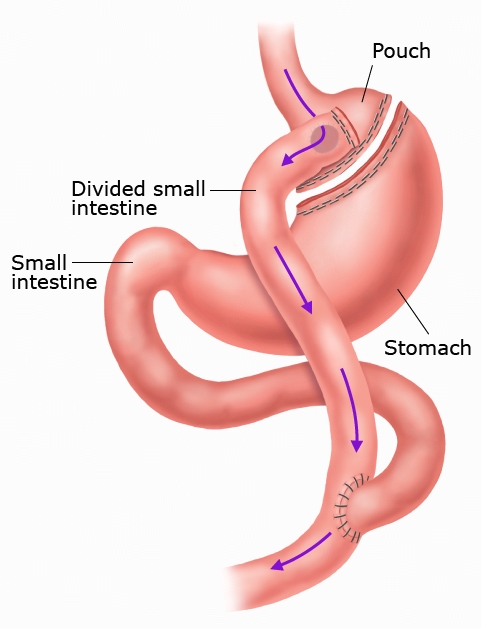
Roux-en-Y gastric bypass, or "RYGB," is a type of weight loss surgery. The doctor closes off part of the stomach, leaving only a small pouch for food. Then, they connect the stomach pouch to the middle part of the small intestine. This lets food "bypass" (go around) part of the stomach and small intestine.
With RYGB, the stomach pouch is connected to the divided small intestine. The arrows show the path food takes through the pouch and divided small intestine after surgery.
Graphic 144041 Version 2.0
figure 2: Gastric sleeve
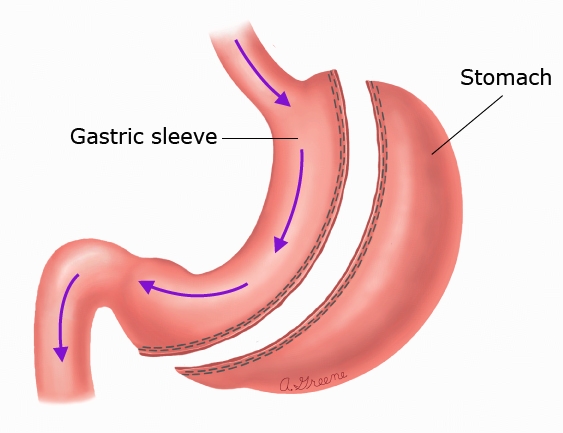
Gastric sleeve is a type of weight loss surgery. The doctor removes a large portion of the stomach and leaves a narrow tube that looks like a sleeve. The arrows show the path food takes through the gastric sleeve after surgery.
Graphic 143986 Version 2.0
Give to a Healthier Future
Help us elevate and expand our care, make breakthroughs in biomedical science and improve community health and wellness.
Healthier communities. Healthiest lives. Together.