
Health Library
Diabetes – Using insulin
You must carefully read the "Consumer Information Use and Disclaimer" below in order to understand and correctly use this information
What is insulin?
This is a medicine many people with diabetes use as part of their treatment. Diabetes is a disorder that disrupts the way the body uses sugar. This causes sugar to build up in the blood.
Insulin can lower a person's blood sugar level. It comes as a shot you give yourself, or as a pump you wear.
What are the different types of insulin?
All types of insulin can help manage blood sugar levels. But some start working faster or last longer than others. Some people use 2 different types of insulin each day:
"Short-acting" or "rapid-acting" insulin works faster and lowers blood sugar levels after meals.
"Long-acting" insulin lasts longer to make sure the body has insulin all day and night.
How many times a day should I use insulin?
It depends. Your doctor will work with you to make a treatment plan that tells you:
When to use insulin
What type(s) of insulin to use
How much insulin to use
Most people use the same amount of long-acting insulin 1 or 2 times a day, at the same time each day. Some people also use short-acting or rapid-acting insulin before each meal, 3 or more times a day. Your plan will depend on how much insulin your body makes and your blood sugar levels.
How much insulin should I use?
Sometimes, people need to choose the dose of insulin to use before a meal. When choosing how much insulin to use, you need to think about:
What you plan to eat at the next meal
Whether you are eating out
How much physical activity you plan to do
Your blood sugar level
Your insulin doses might stay mostly the same over time. But in some situations, the amount of insulin your body needs can change a lot. It is important to talk with your doctor or nurse about changing your doses if you:
Have surgery, or get sick
Get pregnant
Gain or lose weight
If you travel to a different time zone, you might also need to change the timing of your doses. If you are planning a trip, talk with your doctor or nurse.
It is important to take your insulin exactly as your doctor tells you to. Sometimes, people skip insulin doses or try to spread out their doses to make the medicine last longer. This can be dangerous since your blood sugar will not be as well managed. If you are worried about cost, or cannot pay for your insulin, talk to your doctor, nurse, or pharmacist. They might have ways to lower the cost.
How do I give myself an insulin shot?
Your doctor or nurse will teach you how. You need either a prefilled insulin pen injector, or a needle and syringe to draw up insulin from a small bottle.
The pen injectors are easier to use than the older syringes and insulin bottles. They have prefilled insulin cartridges and a needle (figure 1). There is a knob at the end of the pen, which you can turn to mark the number of units you need to take. If you cannot turn the knob to set a dose, there is not enough insulin left in the pen. When this happens, start a new pen.
Here are some tips:
If you use a bottle and syringe, make sure you use the correct syringe for your type of insulin. Using the wrong syringe with your insulin can cause a dangerous insulin overdose.
Whether you are using a pen or a syringe, you can give the shot into different parts of your body (figure 2). Switch areas each time you give yourself a shot.
Never use another person's insulin pen (even if the needle is changed) or let another person use yours.
What is an insulin pump?
This is a device that slowly releases insulin into the body. Some pumps have a thin tube that goes from the pump into the body through an opening in the skin (figure 3). Other pumps stick directly to your skin (figure 4). The device keeps working all day and night.
Why do I need to check my blood sugar level?
Check your blood sugar level at home to know if you are using the right amount of insulin. How many times you should check each day depends in part on how many daily doses of insulin you use.
Checking your blood sugar level is important because it can tell you:
If your blood sugar level gets too low or too high – If you use too much insulin, your blood sugar level can get too low. If you do not use enough insulin, your blood sugar level can get too high. Levels that are too low or too high can lead to serious problems. Talk with your doctor or nurse about what to do if your blood sugar level gets too low or too high.
What changes to make for your next insulin dose – If you take insulin at mealtimes, knowing your blood sugar level will help you choose your next dose.
How well your treatment is working – One goal of diabetes treatment is to keep your blood sugar at or near your goal level. This can lower the risk of health problems later in life.
How do I check my blood sugar level at home?
You can use a "blood glucose monitor" or a "continuous glucose monitor" ("CGM"). Most people who use insulin can use either device. Your doctor or nurse will show you how to use yours.
In general:
Most blood glucose monitors work the same way. You place a "test strip" into the monitor, then prick your skin to get a drop of blood. Many people prick their fingertips (figure 5), but you can prick other parts of your body (picture 1). Then, put the drop of blood on the test strip. After a few seconds, the monitor shows your blood sugar level.
CGM devices measure your sugar level all the time. With CGM, you wear a special sensor that attaches to your skin with a sticky patch (figure 6 and figure 7). It measures the sugar in the fluid under your skin. Then, it sends the information to your smartphone or to a small box that can attach to your clothing or go in a bag. One type of CGM device can be placed under the skin and used for up to 1 year. For this type, a doctor does a minor procedure to insert the device.
If you use CGM, you might still need to check your blood sugar by pricking your skin. This is especially important when your sugar levels are changing quickly, if you have a low sugar level, or if you think your monitor might not be working correctly. When and how often to do this depends on the device.
Images
figure 1: Insulin pen
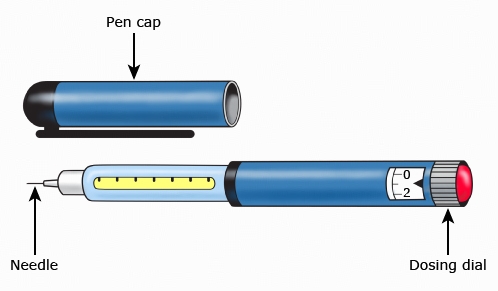
Insulin pens are about the size of regular writing pens. They have a pen cap. They come with prefilled insulin cartridges and have a dial at the top you use to set your dose. You replace the needle each time you use the pen.
Graphic 121143 Version 2.0
figure 2: Where to give an insulin shot
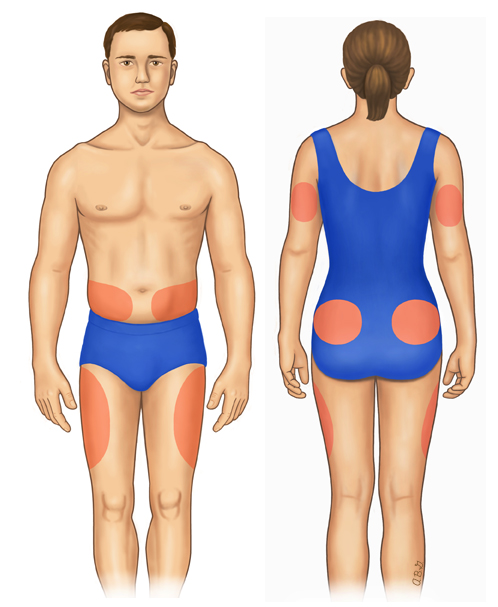
The shaded areas can be used for insulin shots. You should change areas so that you do not use the same area each time. Insulin gets into the blood more quickly when injected into the belly, as compared with the arms or legs.
Graphic 74635 Version 4.0
figure 3: Traditional insulin pump
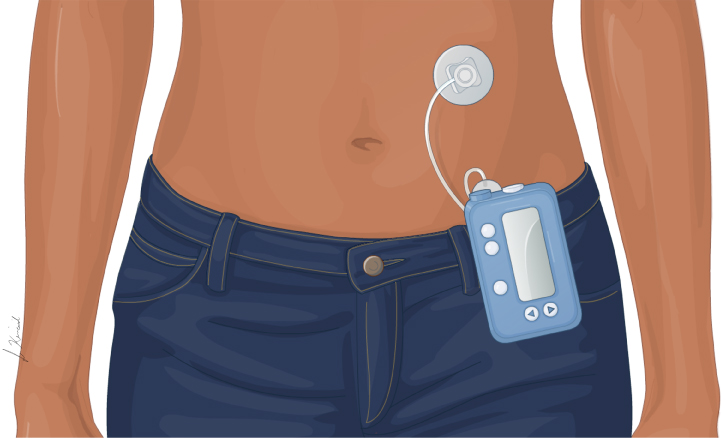
This insulin pump is connected to a tube that is inserted under the skin. The pump containing insulin can be attached to your clothing or carried in your pocket.
Graphic 84008 Version 5.0
figure 4: Insulin patch pump
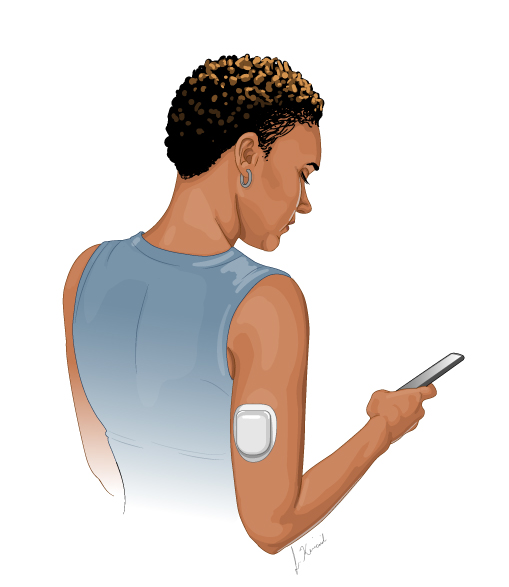
This type of insulin pump sticks directly to the skin and does not use tubing. You use a wireless device to control it.
Graphic 129388 Version 2.0
figure 5: Fingertip testing
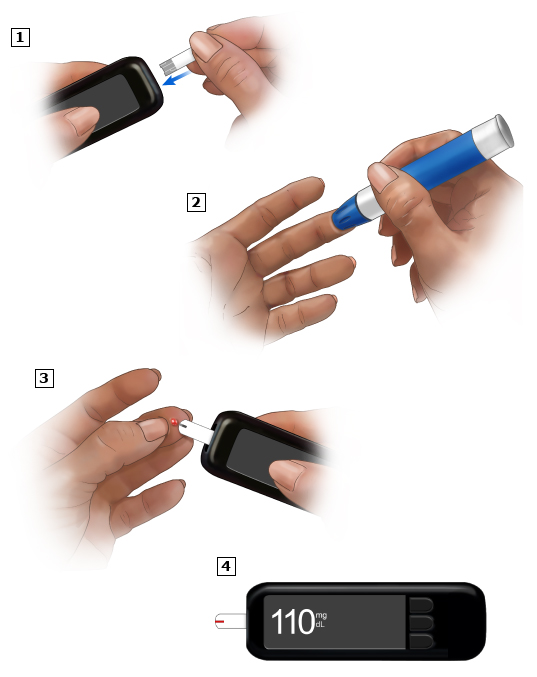
Put a new test strip into the meter.
Use a fresh, small needle or "lancet" to prick your fingertip. You might be able to prick other places, such as your forearm.
Get a drop of blood. You might have to squeeze your finger to get the drop. Touch the edge of the test strip to the drop of blood.
The meter will show your blood sugar level. Write this down so you can share it with your doctor or nurse.
Graphic 57918 Version 4.0
picture 1: Other places to test your blood sugar
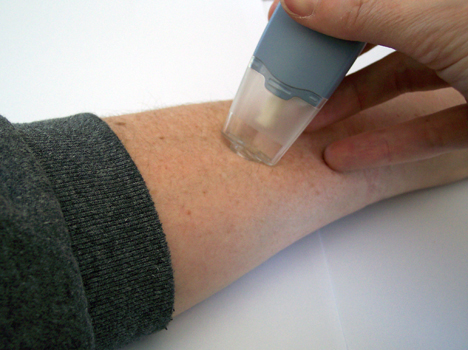
This photo shows how you can test your blood sugar in places other than your fingertips. You might need to gently massage the skin to get a large enough drop of blood. Do not use other places if you think your blood sugar is low.
Graphic 63375 Version 2.0
figure 6: Continuous glucose monitoring
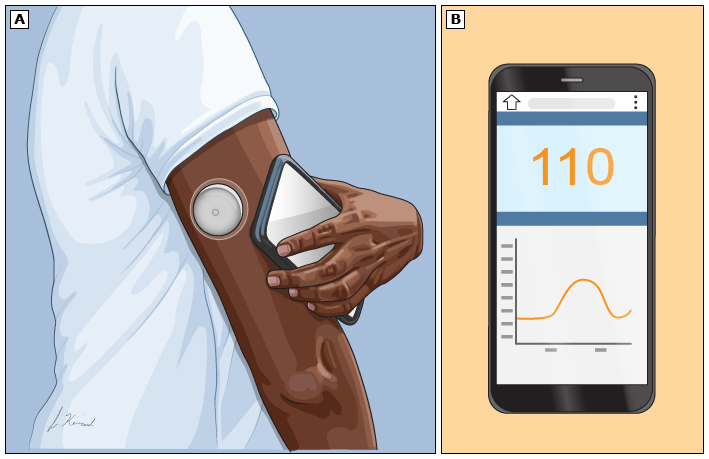
This is an example of an "intermittently scanned" continuous glucose monitoring ("CGM") device. It works with a smartphone app. You hold your phone over the sensor (A), and it gives you information about your blood sugar level (B).
"Real-time" CGM devices automatically and wirelessly send glucose readings to a receiver or smartphone. With these devices, you do not need to scan the sensor to get a reading.
Graphic 134896 Version 3.0
figure 7: Real-time continuous glucose monitoring
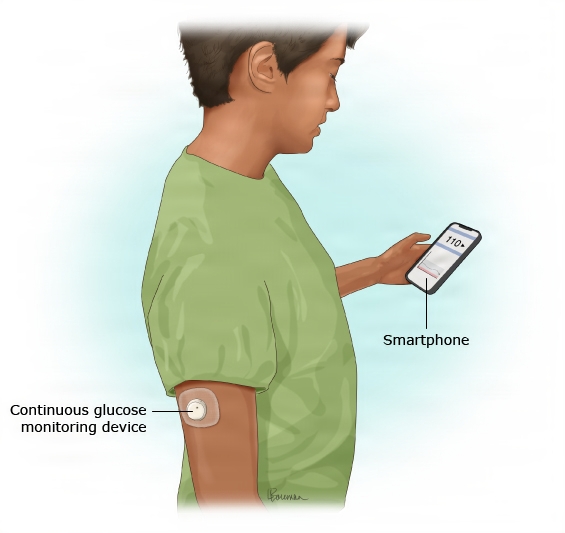
This is an example of a "real-time" continuous glucose monitoring ("CGM") device. It automatically checks your sugar level every few minutes. In this drawing, the device sends the results to a smartphone. Some devices send the results to a "receiver" device.
Graphic 141172 Version 2.0
Give to a Healthier Future
Help us elevate and expand our care, make breakthroughs in biomedical science and improve community health and wellness.
Healthier communities. Healthiest lives. Together.