
Health Library
Asthma in children
You must carefully read the "Consumer Information Use and Disclaimer" below in order to understand and correctly use this information
What is asthma?
This is a disease that affects the lungs and can make it hard to breathe. Some people with asthma have symptoms all the time. Others rarely have any. But most people with asthma have symptoms sometimes.
Asthma can run in families.
What are the symptoms of asthma?
Symptoms can include:
Wheezing, or noisy breathing
Coughing
A tight feeling in the chest
Trouble breathing
Symptoms can happen every day, every week, or less often. They can range from mild to severe, and can come and go. They often happen at night, early in the morning, or during exercise.
What is an asthma attack?
This is when symptoms start suddenly. An asthma attack happens when the airways in the lungs become more narrow and inflamed (figure 1).
Although it is rare, an asthma attack can lead to death.
Is there a test for asthma?
Yes. Your child's doctor might have your child do a breathing test to see how their lungs are working. Most children 6 years and older can do this test. In some cases, the test results might look normal, even if your child has asthma. This might happen, for example, if your child does not have symptoms at the time of the test.
The doctor will also do an exam and ask questions about your child, such as:
What are their symptoms?
How often do they have symptoms?
Do the symptoms wake them up at night?
Do the symptoms prevent them from playing or going to school?
Do certain things make symptoms worse, like having a cold or exercising?
Do certain things make symptoms better, like medicine or resting?
How is asthma treated?
It is treated with different types of medicines that:
Open the airway – This helps the muscles in the airway relax and lets air flow more easily.
Reduce inflammation – This helps calm inflammation and swelling in the airway, which can help prevent asthma symptoms from happening.
The medicines can come as inhalers, liquids, or pills. Your child's doctor will prescribe medicines based on your child's age and symptoms. The medicines your child takes, and how much they need, might change over time.
There are 2 main types of asthma medicines:
Quick-relief medicines – These open the airway quickly to treat asthma attacks. They can reduce symptoms in 5 to 15 minutes. Everyone with asthma should have a quick-relief inhaler to use during an asthma attack. Most people need them 1 or 2 times a week, or less often. But when asthma symptoms get worse, your child might need more doses. Some children get hyperactive and have trouble staying still after taking quick-relief medicines. But this usually does not last very long.
Long-term controller medicines – These help reduce inflammation in the long term. This can help prevent asthma symptoms from happening. Many children with asthma need these, but not all. Your child needs to take them each day if, for example, they have asthma symptoms that bother them often or that are more severe. When these medicines are working well, your child's asthma symptoms are controlled, and they should not need quick-relief medicines very often.
When these medicines are put into inhalers, many children have 1 inhaler for quick relief and 1 for long-term control. In some cases, a child might have 1 inhaler to use for both.
Almost all children with asthma use an inhaler with a device called a "spacer." Younger children might need a machine called a "nebulizer" to breathe in their medicine. The spacer and nebulizer both help get more medicine into the lungs, where it is needed (figure 2). A doctor or nurse will show you how to use them.
It is very important to give your child their medicines exactly as instructed. They might take medicines a few times a day. The doctor, nurse, or pharmacist will show you how to give your child's medicines.
You might worry about giving your child a lot of medicine. But leaving your child's asthma untreated has much bigger risks than any risks of the medicines. Asthma that is not treated properly can:
Prevent a child from doing normal activities, such as playing sports
Make a child miss school
Damage a child's lungs
What is an asthma action plan?
This is a list of instructions that tell you (form 1):
What medicines your child should use at home each day
What symptoms to watch for that could mean the asthma is getting worse
What other medicines to give your child if their symptoms get worse
When to get help or call for an ambulance
You, your child, and their doctor will work together to make an asthma action plan for your child.
Can asthma symptoms be prevented?
There are things you and your child can do to help prevent asthma attacks. Your child's doctor or nurse will talk to you about what is most important for your child.
In general, you should:
Lower your child's risk of getting sick – Viral infections are the most common asthma "trigger" for children. (Triggers are things that make symptoms worse.) Examples include colds, the flu, and COVID-19.
It's important children get the COVID-19 and flu vaccines. This lowers the risk of severe illness if they do get one of these infections.
If you think your child might have an infection, tell their doctor or nurse. They can help decide if your child needs treatment.
Avoid other triggers – Other common triggers include smoke, air pollution, dust, mold, pollen, pet hair, strong chemicals or smells, and very cold or dry air. Exercise and stress can also be triggers. But your child should not avoid exercising to avoid triggering their asthma. This is because exercise is important for staying healthy. Plus, regular exercise and better fitness can actually help their lungs work better and reduce asthma symptoms.
If your child can't avoid certain triggers, talk with their doctor about what they can do. For example, they might need to take an extra dose of their quick-relief inhaler medicine before exercising or being around things they are allergic to.
Know how and when to give your child their medicines – If your child takes controller medicines, follow all the instructions to help prevent symptoms. Make sure you know how and when to give their quick-relief medicine.
See the doctor or nurse regularly – If your child needs asthma medicine every day, they should see their doctor or nurse regularly. For many children, this means every 3 to 6 months. At these appointments, the doctor or nurse will ask about your child's symptoms, check how well their lungs are working, and talk about their treatment plan.
What will my child's life be like?
Most children with asthma can live normal lives. You can help manage your child's asthma if you:
Make changes in your life to avoid your child's triggers.
Keep track of your child's asthma.
Follow your child's action plan.
Tell the doctor when your child's symptoms change.
Sometimes, asthma gets better as children get older. They might not have asthma symptoms once they are adults. But some children still have asthma when they grow up.
When should I call the doctor?
Call for an ambulance right away (in the US and Canada, call 9-1-1) if your child has severe symptoms during an asthma attack, like:
They have so much trouble breathing they cannot talk.
The skin and muscles around their ribs are pulling in with each breath (called "retractions").
Their lips or fingernails are gray or blue.
They are very drowsy or not responding normally.
Call your child's doctor or nurse if:
Your child uses quick-relief medicine for an asthma attack, and their symptoms do not improve, get worse, or come back quickly.
Your child needs to use their quick-relief medicine more than 2 times a week for symptoms.
Your child cannot do their normal activities because of their asthma symptoms.
You have any questions about your child's medicines.
Images
figure 1: Asthma
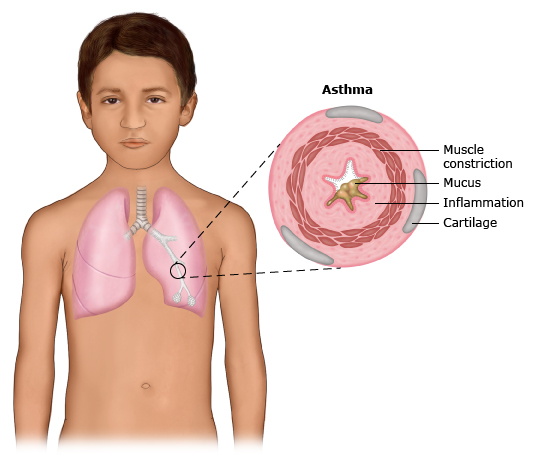
During an asthma attack or flare-up, the muscles around the airways tighten (constrict), and the lining of the airways gets inflamed. Then, mucus builds up. All of this makes it hard to breathe.
Graphic 65956 Version 11.0
figure 2: Using a valved holding chamber or other spacer device
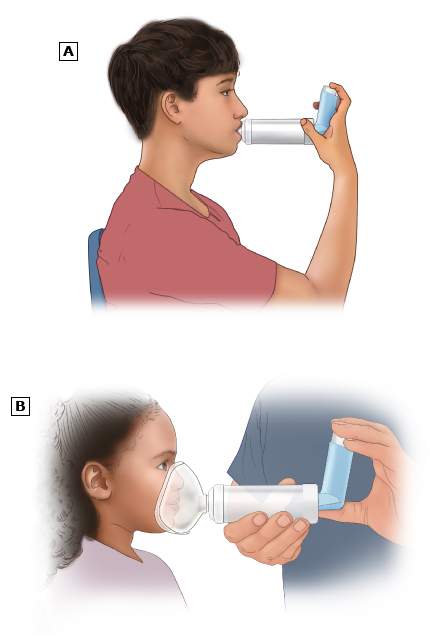
Most children with asthma use an inhaler with a valved holding chamber or other spacer device. This is a device that attaches to the inhaler's mouthpiece. The devices shown in this figure are both valved holding chambers.
(A) When the child presses down on the canister, a puff of medicine is released into the valved holding chamber/spacer. Then, the child breathes it in.
(B) Some valved holding chambers/spacers come with a face mask. If your child's valved holding chamber/spacer has a mask, hold it snugly over their mouth and nose. Then, press down on the canister to release the medicine into the valved holding chamber/spacer. The child can then breathe it in.
Graphic 75577 Version 12.0
form 1: Asthma action plan (child)
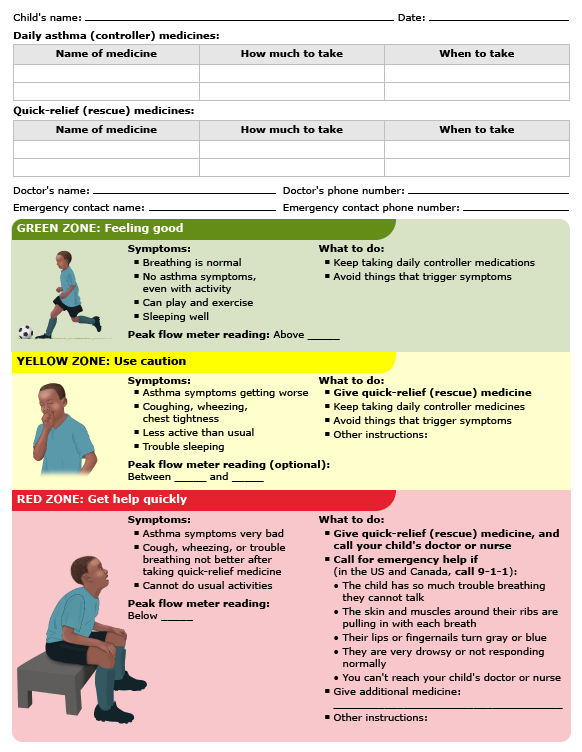
An asthma action plan is a list of instructions that tell you:
What medicines to give your child at home each day, if any
What symptoms to watch for
What other medicines to give your child if their symptoms get worse
When to call the doctor or get emergency help
Graphic 140837 Version 3.0
Give to a Healthier Future
Help us elevate and expand our care, make breakthroughs in biomedical science and improve community health and wellness.
Healthier communities. Healthiest lives. Together.