
Smiles by Mail
The benefit and risk of mail-order orthodontia
Three years ago, when COVID-19 struck, we all covered our faces.
When the masks finally came off, many of us realized – or remembered – that we were self-conscious about our smiles. The internet responded and since then, our social media feeds have filled with offers for at-home teeth straightening systems.
According to Justin Hurlburt, DMD, director of the General Practice Dental Residency Program at The University of Vermont Medical Center, these at-home programs offer “limited ortho” – a quick cosmetic touch-up – as opposed to the comprehensive, full-mouth reconstruction that many of us had as adolescents.
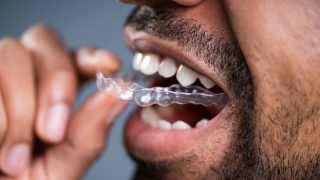
Mail-order programs may start with an in-person scan, but more frequently – especially for patients who live in rural areas like ours – you’ll be sent an impression kit in the mail. From there, affiliated providers create a treatment plan and send custom aligner trays, based on your scan or impressions, to you through the mail. These programs often promise substantial savings over working with a local provider.
Should We Bite?
Dr. Hurlburt understands why the offers are enticing – but he urges caution.
There’s a lot that goes into successful orthodontic work, he says, particularly to make sure treatments don’t move the teeth too much and affect occlusion (how our teeth fit together) when we bite. That requires precision, supervision and the ability to adjust treatment along the way – none of which is possible with a mail-order program.
“When you’re talking about moving teeth, you want as accurate a model as possible. ‘Close enough’ is not okay,” he explains. “That starts with impressions. Here in our office, we use a material that’s much more accurate than what patients get with a mail-order kit. And still, it’s rare that we get it perfect the first time.”
Getting good impressions to send to a lab, he says, can take multiple tries.
Return to Sender
Even under a well-planned, properly supervised orthodontic treatment, there can be side effects, he notes.
For example, after receiving orthodontic treatments, some people experience root resorption, in which the body breaks down the roots of the teeth, which can cause teeth to loosen or even fall out. It’s the same process that causes us to lose our baby teeth.
Sometimes, the underlying bone doesn’t follow the movement of the teeth. This will cause recession, periodontal issues, and eventually, possible tooth loss.
The difference, he explains, is that with in-person treatment, you’re working with an expert who can spot problems along the way and make adjustments if necessary.
The most common adverse result he sees from mail-order orthodontic kits is an increase in cavities. “When you start one of these programs, you need a dentist to sign off, saying you’re in good dental health. But there’s no follow-up required. So for people who don’t get regular dental care and don’t follow the directions to keep their trays clean, they end up with a mouth full of cavities. A lot of times, the teeth can’t be restored.”
On the more extreme end, he’s seen cases where patients end up with TMD (temporomandibular joint dysfunction), or who can’t bite down at all, after completing a mail-order orthodontic treatment where the alignment wasn’t correct.
Start Local
The good news is, the rise of digital dentistry has also made in-person dental and orthodontic care more accurate and more accessible.
“With new digital tools and workflows, we can get 3-D pictures of a patient’s jaw, which makes surgeries and implants easier and more successful,” he explains. All of this has allowed general dentists to offer more in-office procedures. “It’s a great thing, especially in Vermont and northern New York, where access to care is always an issue,” Dr. Hurlburt says.
For people looking to straighten their teeth, Dr. Hurlburt’s advice is to see your local dentist. “There are plenty of dental offices that can do basic orthodontic work properly,” he says. “And for the complex cases, we refer them out to orthodontists.”
A mail-order company, on the other hand, may not always be transparent enough to mail your check back if your case is beyond their expertise.
In short, he says: “Cheap and easy isn’t always the best way to go.”


