Invisible No More
As a Black kid growing up in inner-city Queens, becoming a doctor felt impossible.
As a Black kid growing up in inner-city Queens, becoming a doctor felt impossible.
I’d simply never seen a doctor that looked like me, except occasionally on TV. But in eighth grade, when some of my peers were joining gangs or getting pregnant, I decided to aim for the unattainable: I would become a doctor.
I learned early that my appearance would shape how many people perceive me. I was 8 when I was first stopped by the police because I looked like another boy who had gotten into trouble. My father was 15 when he witnessed his friend, Randolph Evans, murdered by a police officer.
“Don’t die today. Stay out of jail. Finish elementary school. Be invisible. Be invisible.” These are the things I told myself as I tried to make it out.
I am privileged to have loving, supportive parents. They helped me believe I could achieve anything. I first volunteered at a hospital when I was 13, an experience that ultimately led me to medical school and, finally, residency.
It looked like my dream was becoming a reality, but in these predominantly white environments, I found myself talking differently, being more conscious of my appearance and less likely to be open about what I knew or what I didn’t. I didn’t like to ask for help. I didn’t find it easy to be myself. Be invisible.
It was holding me back: I twice failed my Step 2 examination – the “gateway” exam to becoming a doctor – before finally moving on to my residency.
After the 2020 George Floyd murder, I began to find my voice. I realized that I would never succeed professionally, nor be able to support others, if I wasn’t open about my vulnerabilities and challenges as a Black man and physician.
Today I proudly wear my life experience. It makes me a better doctor, helps me find common ground with my patients and be empathetic to the students I work with at Larner College of Medicine. It has also given me the courage to advocate for greater equity in medical education.
I still go to Queens regularly with my wife and kids to visit my family. Sometimes I visit my old elementary school and talk to kids about my path. It makes me grateful for where I have come from and hopeful that with the right support, more kids will become something they once thought impossible.
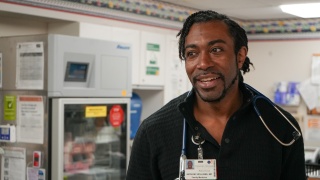
Tony Williams, MD, is a physician at Colchester Family Practice and an assistant dean of admissions at University of Vermont's Larner College of Medicine. He’s been with us for 11 years.