
Project SEARCH Helps Young Adults Discover Capabilities, Careers in Health Care
The program helps participants build confidence, independence and workplace skills
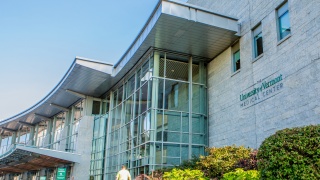
Burlington, Vt. — At the Project SEARCH completion ceremony hosted Wednesday by UVM Health - University of Vermont Medical Center, Stacey Kelleher spoke about the growth she saw in her daughter, Juno, over the past year.
Juno, who has Down syndrome and Type 1 diabetes, entered the program after graduating from Burlington High School. Kelleher says the year offered her daughter a chance to gain real workplace experience while taking an important step toward greater independence.
“She has experienced what it feels like to be a little bit more independent,” said Kelleher.
Kelleher’s words captured the essence of what Project SEARCH offers young adults with intellectual and developmental disabilities: a structured environment where they can discover their capabilities and explore a wide variety of health care careers.
The June 3 ceremony celebrated eight graduates who spent the past year building skills and preparing for employment.
Real Skills, Real Impact
For Juno, the year-long program provided a chance to practice independence in a real workplace setting. Through rotations with several departments at UVM Medical Center, she learned about workplace expectations, communication and daily responsibilities.
The program also helped Juno practice managing her Type 1 diabetes with less direct support than she had during high school. Kelleher said that growth was one of the most meaningful parts of the year for her daughter.
“She managed that on her own,” Kelleher says. “The level of support has definitely gone down.”
Project SEARCH participants go through three, 12-week rotations of about 20 hours per week with multiple hospital departments. Those hands-on experiences are combined with daily classroom instruction. The format gives participants exposure to careers in health care while helping them develop essential workplace and life skills.
On Juno’s last day in one rotation, she got up early to write thank-you cards for the people she had worked with.
“It wasn’t me saying, ‘Give your teacher a thank-you note,’ or anything like that,” Kelleher said. “It was just her being like, ‘Yeah, I want to do this.’”
Transforming Workplace Culture
What makes Project SEARCH unique is its mutual benefit model. While interns gain valuable experience, accommodating different learning styles and abilities helps hospital departments improve their operations for everyone.
"They are actually giving to us so much more than we are giving back to them," said Geera Demers, director of Culture and Experience at UVM Medical Center, of how the program benefits everyone involved. "Project SEARCH requires us to really engage and recognize that we can't always do things the same way."
The program creates opportunities throughout the hospital to rethink how teams train, communicate and support colleagues, patients and visitors. Staff members learn to adapt to different communication styles and create more inclusive environments.
"These challenges became opportunities to innovate and foster an environment of patience, adaptation, and mutual respect," said April Hatterick, Radiology Program manager for UVM Medical Center.
A Model for Vermont
Project SEARCH showcases a collaborative approach to health care, education and social services. At UVM Medical Center, the program is operated in partnership with South Burlington School District, Howard Center, HireAbility Vermont and the Vermont Agency of Education.
The model brings together classroom instruction, hands-on work experience and individualized support to help young adults prepare for employment and adult life. Interns gain experience in hospital departments while also learning skills such as communication, professionalism, resume writing and workplace expectations.
The program can also provide an important bridge between school and adulthood. Kelleher said the year helped Juno become more independent while giving their family time to think about what work, structure and support may look like after graduation.
“It’s not only her transitioning into adulthood,” Kelleher said. “It’s also us beginning to get our heads around what it’s going to mean for Juno to be out of a school environment.”
Looking Ahead
Demand for the program continues to grow. Each year, Project SEARCH helps young adults gain hands-on experience, build workplace confidence and prepare for future employment.
Since 2018, UVM Medical Center has hired seven Project SEARCH graduates, with others finding employment throughout Chittenden County.
“Project SEARCH is the best of the best in terms of training for your future careers,” said John Spinney, Post-Secondary Transition Coordinator for the Vermont Agency of Education, speaking to the interns who completed this year’s program. “Listen to your heart, communicate your needs, trust the process and take all that you’ve learned and use it in your life.”
University of Vermont Health
40 IDX Drive
South Burlington, VT 05403
###
About Project SEARCH
Project SEARCH is a business-led, one-year internship program for young adults with intellectual and developmental disabilities. UVM Medical Center is one of three sites that host the program in partnership with Vermont schools, along with Dartmouth Hitchcock Medical Center.
Project SEARCH is operated in partnership with Howard Center, South Burlington School District, HireAbility Vermont and the Vermont Agency of Education. Interns complete three, 12-week rotations in hospital departments while also receiving daily classroom instruction focused on workplace skills, communication and professional development.
Project SEARCH operates at more than 798 sites worldwide.
About University of Vermont Health
University of Vermont Health is a rural academic health system with more than 100 years of service to small towns and cities across Vermont and northern New York. We are deeply committed to reimagining rural health in ways that will benefit our communities for generations to come and keep exceptional care close to home. Our system includes an academic medical center, two community hospitals, three critical access hospitals, a children’s hospital, a cancer center, a multispecialty medical group, 154 outpatient sites and care beyond the hospital through home health, hospice care, four skilled nursing facilities and other support services. Our care is informed by an essential partnership with University of Vermont’s The Robert Larner, M.D. College of Medicine and College of Nursing and Health Sciences. Together, as a health system serving a rural area, we are tackling health care’s biggest challenges — supporting the communities we serve and investing in our employees by addressing housing affordability, quality childcare and professional development needs. To learn more, visit us at www.uvmhealth.org.