
Midwifery Program Expands in Central Vermont
A holistic, community-based OB/GYN program including midwifery care and expanded GYN services for older patients contributes to Vermont’s national leadership in maternal health.
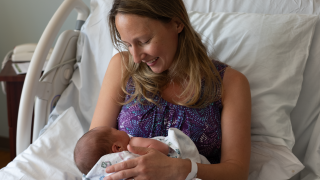
Berlin, Vt. – When University of Vermont Health – Central Vermont Medical Center (CVMC) began a years-long planning process focused on adding more certified nurse midwives to its OB/GYN practice, the goal was clear: respond to the community’s call for more access to midwifery care by building a sustainable, collaborative model for reproductive health.
In early 2025, when the hospital finalized the program’s expansion to four certified nurse midwives (CNM) to its medical staff, that vision was fully realized. The CNMs now provide 24/7 coverage and care for expectant parents with low-risk pregnancies, and physician-supervised care for those with moderate-risk pregnancies.
The hospital’s reimagined and expanded Midwifery and gynecology programs are a direct response to community feedback and requests for expanded access to midwifery-based perinatal care. They also showcase the health system’s response to national trends and challenges related to delivering OB/GYN care in rural communities. In particular, the power and importance of connections between providers and patients and the need to expand access to surgical gynecology and menopause care as the state undergoes a significant demographic shift.
"We are taking care of our friends, neighbors and colleagues," said Colleen Horan, MD, site director for CVMC’s Department of Obstetrics and Gynecology. “It makes our commitment to quality care very personal.”
Building Collaborative Care
In a time of growing challenges in rural obstetrical care, CVMC’s investment in midwifery reflects a long-term commitment to community-rooted solutions.
"When I first came here in 2011, there wasn’t a strong relationship between physicians and midwives," said Dr. Horan. "We recognized the benefits of midwifery for low-risk pregnancies and wanted to create something collaborative."
The program started intentionally small, with two midwives providing daytime care alongside physicians who were trained to work in team-based settings. That kind of training helps providers understand each other’s roles, communicate more effectively, and focus together on what’s best for patients. As those relationships strengthened, the program has expanded to four midwives offering full, 24/7 coverage.
"I moved back to New England five years ago, drawn by my love for the region and the opportunity to help shape a collaborative midwife-physician practice model at CVMC," said Corey Gilkey, CNM, who joined the hospital in 2020 and was instrumental in recruiting additional midwives. "We knew that the community had a strong desire for full-time midwifery care and were able to add four full-time midwives over the last year to provide our patients with 24/7 coverage."
The effort also attracted Callie Linehan, MD, a family medicine physician with specialized obstetrics training who connects pregnancy care with long-term family health. Dr. Linehan’s addition to the hospital’s medical staff has helped CVMC pursue a holistic vision of perinatal care.
"Pregnancy is one period in somebody's life," said Dr. Horan, "but conditions like depression, high blood pressure and diabetes need continued care afterwards."
Comprehensive Local Care
CVMC’s OB/GYN program offers breadth and continuity that can be difficult to find in rural obstetrical care. The hospital’s team of midwives care for expectant mothers experiencing low-risk pregnancies, while physicians like Rachel Long, MD, and Molly Flanagan, MD, provide specialized surgical services, including minimally-invasive gynecologic surgery. Dr. Horan focuses on addressing the unique needs that arise during the perimenopause and menopause transition, and has earned certification by the Menopause Society, a nonprofit organization that provides evidence‑based tools and education to support women through menopause and midlife well‑being.
"Low-risk obstetrics, surgical gynecology, menopause care – we have the pieces in place," said Dr. Horan.
The team also integrates mental health support throughout pregnancy and postpartum care through Jennifer Auletta, MA, LCMHC, BC-DMT, a perinatal mental health counselor. It provides one-on-one nursing education sessions and collaborates with community services including home health teams, Good Beginnings – a nonprofit that supports new parents – and the Doula Project, through which Washington County Mental Health Services provides prenatal, labor and postpartum support.
Contributing to Statewide Excellence
CVMC's investment in collaborative midwifery care reflects the statewide work that led to Vermont being the only state in 2024 to achieve an ‘A’ grade on the March of Dimes annual Report Card.
The Report Card highlights factors that contribute to maternal and infant health, including pre-term birth rates, infant mortality rates, cesarean birth rates and the number of residents who do not receive adequate prenatal care. Vermont had the lowest preterm birth rate of any state, and the highest rate of adequate prenatal care in the nation.
The high rankings demonstrate the impact of community-based programs like CVMC’s that emphasize prevention and reduce unnecessary interventions.
From 2018 to 2022, CVMC’s low-risk cesarean rate dropped from 34.9% to 22.6%, based on data from the Vermont Child Health Improvement Program (VCHIP). The decline aligned with the beginning of the program’s expansion of midwifery care.
Dr. Horan and other providers practicing in the hospital’s program also say they have seen improvements in patient satisfaction, through those improvements are anecdotal at this point. Team members say the improvements are the result of stronger continuity of care and better support during pregnancy and postpartum, as well as Integrated mental health and comprehensive nursing care.
Looking Ahead
CVMC's expansion of midwifery care and gynecology services tailored to older patients represents a commitment to sustainable, community-centered health care. For Vermont families, this means access to comprehensive reproductive health care delivered by providers who understand that quality care requires both clinical excellence and personal relationships.
“It’s rooted in Vermonters wanting a more patient-centered experience that minimizes interventions,” said Dr. Long, medical director of CVMC’s birthing unit. “Midwifery care has clear benefits – including lower interventions and fewer C-Sections. It’s not a model that is used a lot in America, but that’s hopefully where we are headed.”