
Anesthesia Emissions Reductions Save Thousands
Changing how one anesthesia gas is delivered to operating rooms at UVM Medical Center is saving the hospital money and reducing the climate impacts of health care
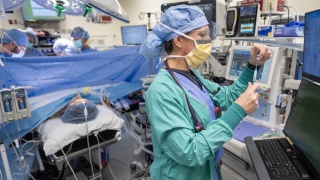
Burlington, VT – Changing how one anesthesia gas is delivered to operating rooms at University of Vermont Medical Center is saving the hospital money and reducing emissions of one of the most potent man-made greenhouse gases – a key outcome for improving sustainability and reducing climate impacts in health care.
The hospital recently switched from using centralized piping lines to convey nitrous oxide to operating rooms (OR) to an e-cylinder system. E-cylinders are self-contained tanks that are mounted directly onto anesthesia machines in the OR.
The changes will save the hospital more than $10,000 each year, reducing nitrous oxide purchases by 88 percent. Moving to e-cylinders also eliminated the emissions equivalent of 483 metric tons of carbon dioxide – roughly the carbon footprint of 65 homes’ energy use for one year.
Anesthetic gases like Nitrous Oxide are among the most potent man-made greenhouse gases. While the substances have heat-trapping properties hundreds or thousands of times greater than carbon dioxide (CO2), the relatively low amounts released mean they have only a fraction of the climate impact of CO2. Even so, Nitrous oxide accounts for a significant portion of hospitals’ ozone-depleting emissions, according to the American Society of Anesthesiologists. A study published in 2024 found that emissions of the gas grew 40 percent between 1980 and 2020.
Still, anesthesiologists like Amy Odefey, MD, are always searching for ways to improve sustainability and reduce waste. The nitrous oxide emissions reduction project at UVM Medical Center was launched by recently retired anesthesiologist Catherine Christenson, MD, in collaboration with departments across the hospital. Dr. Odefey, who now leads the anesthesia department’s sustainability efforts, is working to roll out the changes to hospitals across UVM Health Network.
“We are always looking for low-hanging fruit – either something that’s extremely toxic to the environment which we can eliminate or limit, or disposables that have a re-usable alternative that’s feasible to switch to,” said Dr. Odefey. “Moving from a piped delivery system to e-cylinders puts the anesthesia right where it is needed and reduces emissions of a powerful greenhouse gas.”
The hospital’s anesthesia department worked directly with members of UVM Medical Center’s bio-med, perioperative services and environmental services teams, as well as the health system’s sustainability department, to make the change and involve anesthesia teams across the health system, with the goal of implementing the e-cylinder shift at other hospitals.
Dr. Odefey emphasized that the change does not impact patient care or anesthesia best practices at the hospital.
“In terms of anesthesia care, we aren’t taking a resource away,” said Dr. Odefey. “It is still readily available – we’re just using a different way to get Nitrous Oxide to where it needs to be.”